Certification - (FTZ) Foreign Trade Zone
Updated: Nov 1, 2025
SOLO World Partners’ Riverview, MI Facility Achieves Foreign Trade Zone (FTZ) Designation
Riverview, MI – 29-JAN-2013 – SOLO World Partners is proud to announce that its Riverview, Michigan facility has been officially approved as a Foreign Trade Zone (FTZ). This designation marks a significant milestone in SOLO’s mission to provide cost-effective, efficient, and streamlined global supply chain solutions to its valued customers.

Foreign-Trade Zones (FTZs) in the U.S.:
FAQ
What are Foreign-Trade Zones (FTZs) and what is their primary purpose?
Foreign-Trade Zones (FTZs) are designated areas within the United States, typically located near ports of entry, where domestic and foreign merchandise is considered outside U.S. customs territory for tariff purposes. The primary purpose of FTZs, established by the Foreign-Trade Zones Act of 1934, is to promote U.S. competitiveness in international trade, stimulate domestic employment and investment, and streamline supply chains by reducing tariff costs on imported inputs and exported finished products. Goods can be imported, stored, manipulated, manufactured, or re-exported within these zones without immediate customs duties or excise taxes. Duties and taxes are only due when the merchandise is transferred from the FTZ into U.S. commerce.
What are the main benefits for businesses operating within an FTZ?
Businesses operating within an FTZ can realize several significant benefits:
Duty Deferral and Elimination: Import duties and excise taxes are not paid until merchandise leaves the FTZ for U.S. consumption. If goods are re-exported from the FTZ, duties and taxes may be eliminated entirely.
Inverted Tariff Benefits: If the duty rate for a finished product manufactured within the FTZ is lower than the duty rates of its imported component parts, companies can pay the lower finished product duty rate when the goods enter U.S. commerce, while keeping manufacturing operations within the U.S.
Streamlined Logistics: Imports can be directly delivered to the zone upon Customs approval, and a single entry can be filed for up to seven consecutive days' worth of entries and exports. Operators may also be permitted to break and affix Customs seals.
Quota Avoidance (in some cases): Merchandise subject to quota can sometimes be held within an FTZ even after the quota has been met, allowing access to potentially discounted inputs and the ability to admit merchandise as soon as a new quota year begins. Also, certain quota-subject inputs can be processed in the zone to create a product not subject to a quota.
Improved Cash Flow and Inventory Management: By deferring duties, businesses can improve their cash flow. FTZs also support automated recordkeeping and document storage, increasing supply chain visibility and aiding inventory control.
Reduced Regulatory Burden for Re-exports: Lessened U.S. regulatory agency requirements apply to merchandise destined for re-export from an FTZ.
State and Local Tax Exemptions: Imported tangible personal property stored or processed in a zone, or U.S.-produced property held for export, is exempt from certain state and local ad valorem taxes.
What are the different types of FTZ sites and how do they function?
There are primarily two frameworks for FTZ sites:
Traditional Site Framework (now largely replaced by ASF): This framework historically included "general purpose zones" (now "magnet sites") and "subzones." Subzones were approved for specific companies outside general-purpose zones to leverage FTZ benefits without relocating.
Alternative Site Framework (ASF): This optional, streamlined framework provides greater flexibility. Grantees (the corporations authorized to establish and maintain FTZs) are granted 2,000 "virtual" acres to designate sites within their service area.
Magnet Sites: These are typically industrial parks or multi-tenant sites already designated by the Foreign-Trade Zones Board. Once a company in such a park wishes to operate as an FTZ, they only need to go through a designation process with the grantee and local customs.
Usage-Driven Sites: These sites are designated to meet a specific operator or user's present need for FTZ status and require a designation and activation process with the grantee and the Foreign-Trade Zone Board. They replace the role of subzones, allowing companies to operate under FTZ status even if located outside traditional general-purpose zones. Usage-driven sites are tied to a specific user and typically have a three-year "sunset limit" which resets with continued activity.
What types of activities are permitted or restricted within an FTZ?
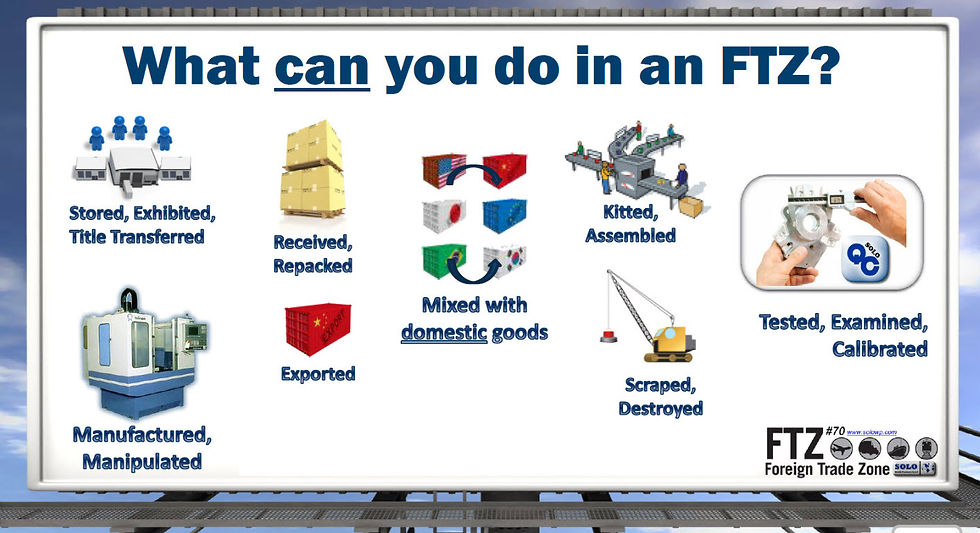
Generally, any merchandise not prohibited from entry into the U.S. can be admitted into an FTZ. Permitted activities include:
Storage, exhibition, manipulation (e.g., packing, unpacking, repacking, testing, cleaning, sorting, grading), mixing with foreign or domestic merchandise, assembly, and distribution.
Manufacturing and processing are allowed but must be specifically approved by the FTZ Board, especially if they result in a change in tariff classification or a significant expansion of production, or if they involve new sourcing materials subject to inverted tariffs. Restrictions include:
Prohibited Merchandise: Items whose importation is generally prohibited by U.S. law cannot be admitted.
Retail Trade: Selling goods or services directly to consumers in small quantities is prohibited within active portions of FTZs without special permit.
Certain Manufacturing/Processing: Specific restrictions apply to the manufacturing of alcohol, tobacco, and firearms, as well as certain steel, sugar, and petroleum products, often to prevent circumvention of taxes, quotas, or duty rates.
Residency: No person is allowed to reside within an activated area of an FTZ, with limited exceptions for federal, state, or municipal personnel deemed necessary.
Public Interest Exclusion: The FTZ Board can exclude any goods or processes deemed detrimental to the public interest, health, or safety.
How is merchandise tracked and regulated within an FTZ?
Merchandise within an FTZ is subject to rigorous tracking and regulation by U.S. Customs and Border Protection (CBP) and the FTZ Board.
Zone Status: Merchandise is assigned a "zone status" upon admission, such as Privileged Foreign Status (PFS), Non-Privileged Foreign Status (NPFS), Domestic Status, or Zone-Restricted Status (ZR). This status determines how duties and taxes are assessed upon entry into U.S. commerce or re-export. For example, PFS "locks in" the tariff rate based on the merchandise's condition at the time of admission, regardless of subsequent processing.
Inventory Control and Recordkeeping: Operators are required to maintain a robust inventory control and recordkeeping system, often using a "zone lot number" (specific identification) or "unique identification number" (UIN) system. This system must accurately account for all merchandise received, stored, manipulated, manufactured, destroyed, or transferred. CBP conducts compliance reviews and audits to ensure adherence to these requirements.
Permits: Operations like manipulation, manufacturing, destruction, exhibition, or temporary removal require a permit from the Port Director, typically using CBP Form 216. Admission of merchandise into the zone uses CBP Form 214 or the electronic e-214.
Bonds: FTZ Operators must execute an Operator's bond to ensure compliance with laws and regulations, covering potential duties and taxes on merchandise that goes missing or cannot be accounted for.
What is "inverted tariff" and how does it benefit businesses in FTZs?
"Inverted tariff" refers to a situation where the duty rate for a finished product is lower than the duty rates of its component parts or raw materials. This scenario primarily benefits manufacturing industries operating within an FTZ. By manufacturing the finished goods inside the FTZ, U.S. importers can admit their components duty-free into the zone. When the finished product is then transferred from the FTZ into U.S. commerce, they only pay the lower duty rate applicable to the finished product, specifically on the foreign content. This allows them to avoid paying the higher duty rates that would have been applied if the component parts were imported directly into U.S. customs territory, while still keeping manufacturing operations in the U.S. Industries like automotive, pharmaceutical, oil refining, electronics, and machinery/equipment often benefit from inverted tariffs.
How is the Foreign-Trade Zone program overseen and by whom?
The U.S. Foreign-Trade Zone program operates under a dual authority structure:
Foreign-Trade Zones Board (FTZB): Consisting of the Secretary of Commerce (Chair) and the Secretary of the Treasury, the FTZB is responsible for the overall establishment, maintenance, and administration of zones, including prescribing rules, issuing grants of authority for FTZs and subzones, approving manufacturing and processing activities, and making public interest determinations. They report annually to Congress on zone operations.
U.S. Customs and Border Protection (CBP): Part of the Department of Homeland Security, CBP is responsible for the day-to-day oversight of FTZ operations to protect revenue and ensure compliance with customs laws. This supervision is primarily conducted through audit-based compliance reviews and spot checks rather than continuous on-site monitoring. CBP personnel, particularly the Port Director, play a crucial role in approving admissions, transfers, and ensuring security within the zones.
What are some recent trends and major players in the U.S. FTZ landscape?
In 2023, there were 200 active FTZs with over 550,000 employees across 1,300 active operations. While the total value of merchandise received was nearly $949 billion (a slight decrease from the previous year), domestic merchandise accounted for a significant 68% of shipments, indicating a strong integration of foreign and domestic inputs in FTZ activities.
Texas, Louisiana, California, South Carolina, and Tennessee consistently rank high in overall FTZ economic impact. Notable top-performing FTZs in 2023 included:
FTZ No. 124 at the Port of South Louisiana (PortSL): Ranked #1, it experienced significant tonnage increases in animal feed, chemicals/fertilizers, and sugar/molasses, handling over 248 million short tons and receiving over $50 billion in merchandise. It is also leading diversification efforts into sustainable projects and green energy.
FTZ No. 28 in Spartanburg County, South Carolina.
FTZ No. 116 (Port Arthur) and FTZ No. 84 (Port Houston) in Texas: Texas demonstrates strong FTZ leadership with three zones in the top six. FTZ 116 and 122 (Port of Corpus Christi) were notable for oil and petroleum refining activity, drawing in significant merchandise value.
FTZ No. 7 in Mayaguez, Puerto Rico: Moved up to tied #5, driven by its bustling pharmaceutical industry, including major companies like Eli Lilly and Company, Bristol Myers Squibb Company, and AbbVie, which accounted for over $6.1 billion in production activity.
FTZ No. 98 in Birmingham, Alabama: A top performer due to Mercedes-Benz U.S. International's production activity, including $10 billion in production and $5 billion in exports.
Emerging trends include significant investments in green hydrogen and sustainable energy projects, as seen at PortSL, and the increasing adoption of the Alternative Site Framework for greater flexibility in designating new zone sites. International ports are also focusing on resilience, new technology, and green infrastructure, with a significant portion of global trade moved by sea and containerized cargo. Efforts to establish "green shipping corridors" between major international ports like Algeciras (Spain) and Rotterdam (Netherlands), and between Singapore and Japan, highlight a growing focus on decarbonization and digitalization in maritime industries.